
Reusable Metal Base: The Strategic Solution for Packaging Heavy Printing Machines

As printing machines become larger, more complex, and more expensive – packaging must evolve as well. Equipment weighing many tons, sensitive to shocks and environmental conditions, can no longer rely on disposable packaging solutions. This is where the EcoBox comes in – a modular packaging system that provides a unique answer to the challenge of transporting heavy printing machinery, with its core component: the reusable metal base.
Smart Reverse Logistics with EcoBox – Upgrading the Return Supply Chain
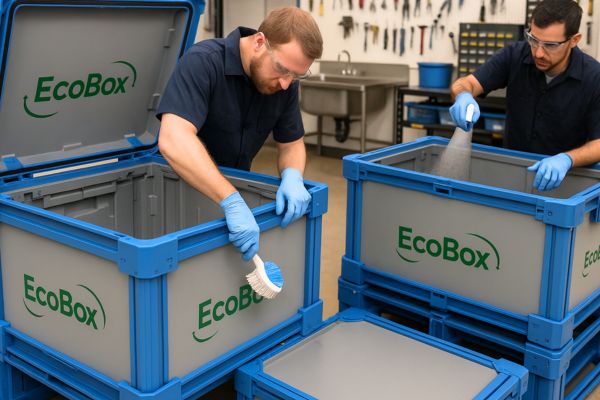
In a world where sustainability, resource efficiency, and logistical optimization are crucial to organizational success, reverse logistics is taking center stage. EcoBox offers an innovative reverse logistics system that delivers cost savings, improved sustainability metrics, and significant operational efficiency for organizations worldwide.
High-Volume Reverse Logistics – The Challenge and the EcoHandling Solution
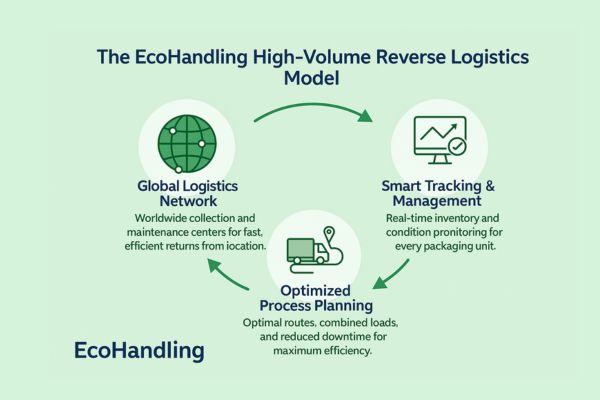
In today’s business environment, where sustainability and resource optimization are integral to corporate strategy, reverse logistics has become a key factor in supply chain management. Returning packaging for reuse enables cost savings, environmental protection, and improved transport processes. However, one of the main challenges in reverse logistics is the ability to operate a large-scale collection network – something traditional logistics systems are not always built to handle.
Reverse Logistics on a Global Scale: Navigating Coordination, Regulation, and Borders

Managing a return system based on reusable packaging is no longer just a local logistical challenge – it’s a central part of a global operational strategy.
In the world of EcoHandling, where EcoBox containers are deployed across international projects, two key challenges define the success of the system: the geographic dispersion of return points and the regulatory complexities of cross-border movement.
To ensure reverse logistics truly performs, the solution must not only collect items – it must know how to coordinate, manage, and comply with the changing requirements of every location, country, and client.
The First Mile in Reverse Logistics: The Challenge That Defines System Efficiency

As reverse logistics solutions become a new standard, especially in the context of reusable packaging, technological components, or operational systems, a critical stage emerges as the true test of success: the first mile.
While the last mile in forward logistics is considered costly and complex, in reverse logistics, the real challenge begins at the first point of return.
The reverse logistics system operated by EcoHandling, based on a global network of service and collection centers, is specifically designed to overcome this crucial stage – where the effectiveness of the entire system is determined.
Circular Economy in Industrial Packaging: More Than a Resource – A Strategic Tool

In a world where raw material costs are rising, availability is limited, and environmental awareness has become a standard requirement, the concept of the circular economy has taken center stage. This is not just a green trend, but a comprehensive industrial approach that reshapes how products – especially packaging – are developed, used, and reused.
Reusable packaging systems like EcoBox are a practical embodiment of circular economy principles, transforming the protective case from a one-time container into a strategic asset within the supply chain.
This article explores how circularity enhances industrial packaging, the role of recycled materials, and the operational and long-term advantages of multi-use packaging in complex logistics systems.
Operational Safety – Advantages for Assemblers, Packers, and Handlers

In a well-functioning global supply chain, the people behind the process are just as important as the product itself. Assemblers, packers, and logistics personnel play a vital role in ensuring efficiency, reliability, and performance at every stage. Their safety, comfort, and confidence directly influence the success of operations.
The EcoBox team has identified how adopting reusable EcoBox packaging creates a safer, smoother working environment – while also streamlining workflows, improving accuracy, and empowering every team member involved.
Reducing Risk Across the Supply Chain with EcoBox Packaging
The modern supply chain involves many stages – planning, production, packaging, storage, transport, unloading, and final delivery. Each step brings its own risks: physical, logistical, operational, and financial. The more complex the supply chain, the more crucial it becomes to rely on durable, standardized, and intelligent packaging systems that support the product throughout its journey.
A Stronger Package = Better Protection Throughout Shipping
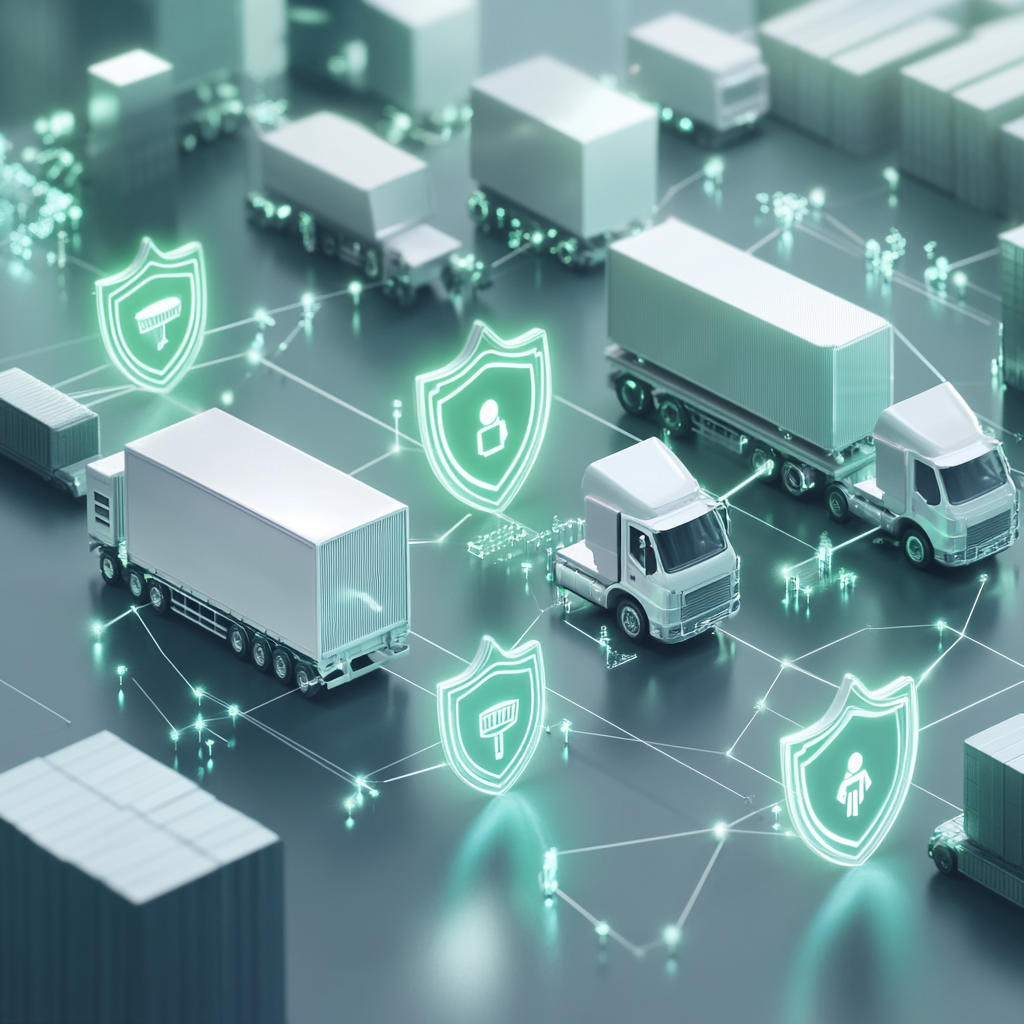
When a product is shipped to its destination, it undergoes a demanding journey – between factories, warehouses, containers, trucks, and sometimes even air freight. Every step along the way poses a potential risk to the integrity of the product. The EcoBox team has examined how durable and well-designed packaging contributes to protecting the product and reducing risk throughout the shipping process.
The safety advantage is not just in delivering an undamaged product – but also in operational peace of mind, reduced liability, and increased customer trust.
Reusable Packaging as Part of a Comprehensive Organizational Safety Policy

The world of logistics, manufacturing, and transport is rapidly evolving—and with it, so does the organizational understanding of the role packaging plays. While once considered a purely functional item, packaging is now recognized as an integral part of broader organizational policies that include sustainability goals, cost reduction, product protection, and above all—worker safety throughout the supply chain.
This article explores how reusable packaging – especially the EcoBox system—fits into a comprehensive safety policy and positively impacts a wide range of internal processes.