
For decades, industrial packaging was designed primarily around a single objective: protecting products during transportation. Once the shipment reached its destination, the packaging had largely completed its role within the supply chain.
Today, this perception is beginning to change. Across global logistics networks, packaging is increasingly becoming part of a broader operational infrastructure connected to reuse, traceability, return flows, and long-term supply chain efficiency. As European markets prepare for the implementation of PPWR in August 2026, many companies are reassessing how packaging functions throughout the entire logistics cycle rather than focusing only on outbound transportation.
This transition is especially visible in industrial B2B supply chains where packaging moves continuously between manufacturers, warehouses, distributors, integrators, and end customers across multiple countries and shipment cycles.
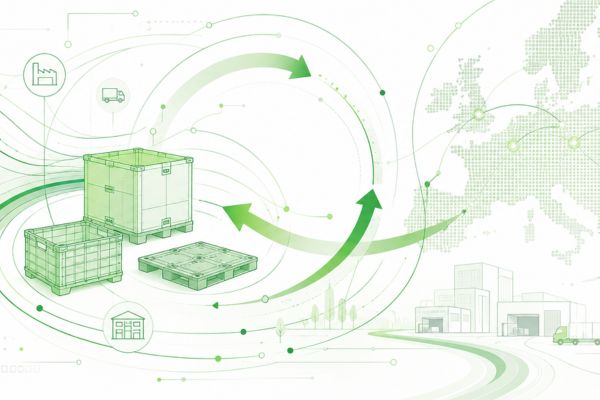
Packaging Is Becoming Part of Operational Infrastructure
One of the most significant changes taking place in global supply chains is the growing understanding that packaging influences far more than shipment protection alone.
Reusable packaging systems increasingly affect transportation planning, warehouse coordination, return logistics, asset availability, operational continuity, and supply chain visibility. In many industries, packaging is gradually becoming integrated into long-term logistics planning and infrastructure management.
This shift is encouraging companies to move away from disposable shipment models toward more structured reusable logistics programs capable of supporting continuous operational flows. The conversation is therefore evolving from “shipping packaging” toward “packaging infrastructure.”
According to operational trends observed by EcoHandling, exporters and importers are increasingly evaluating how reusable packaging systems can support more stable and measurable logistics operations across international supply chains moving into Europe.
Circular Logistics Requires Ongoing Packaging Movement
Circular logistics models operate very differently from traditional one-way shipment structures. Instead of packaging disappearing after delivery, reusable systems require packaging to continue circulating throughout the supply chain.
This creates an ongoing operational cycle involving delivery, collection, consolidation, return transportation, inspection, maintenance, and preparation for reuse. As a result, packaging itself becomes part of a controlled operational network rather than a temporary transport material.
The complexity of these logistics cycles increases significantly in international supply chains where packaging moves across multiple countries, facilities, and logistics partners. Companies therefore require greater coordination, stronger visibility, and more organized reverse logistics capabilities in order to maintain packaging circulation efficiently.
EcoHandling specializes in global reverse logistics and reusable packaging operations designed to support these continuous packaging flows. The company is increasingly seeing demand for solutions capable of supporting long-term packaging circulation across international B2B logistics programs.
Visibility and Control Are Becoming Essential
As packaging becomes part of operational infrastructure, visibility and control become increasingly important. Companies want to know where packaging assets are located, how efficiently they are moving, and whether return cycles are functioning according to operational requirements.
This transition is encouraging organizations to manage packaging more similarly to operational equipment or logistics assets. Packaging availability now influences shipment planning, operational continuity, and warehouse coordination across many industries.
The growing importance of packaging traceability is also connected to broader supply chain visibility initiatives taking place across Europe. Businesses are increasingly looking for logistics structures capable of supporting reusable flows while maintaining operational transparency across the network.
Reusable industrial platforms such as EcoBox are increasingly being evaluated within these environments because they support repeat international shipment cycles while enabling more structured packaging management and operational consistency.
Packaging Platforms Are Supporting the Next Generation of Supply Chains
The broader movement toward circular logistics is reshaping how companies think about packaging strategy. Packaging is no longer viewed only as a transportation necessity. Increasingly, it is becoming part of the operational architecture supporting long-term supply chain performance.
This transition is influencing decisions related to packaging standardization, logistics efficiency, return coordination, asset management, ESG readiness, and operational scalability. Companies moving goods into Europe are gradually recognizing that reusable packaging systems require organized infrastructure, global coordination, and structured reverse logistics operations in order to function effectively at scale.
Organizations specializing in reverse logistics and reusable packaging networks, such as EcoHandling, are already supporting this operational transformation through worldwide return coordination and reusable packaging programs designed for circular supply chain environments. Solutions such as EcoBox are increasingly becoming part of the infrastructure supporting continuous global packaging movement rather than isolated one-way shipment operations.