
European supply chains are entering a new phase of packaging accountability. With the Packaging and Packaging Waste Regulation (PPWR) scheduled to take effect across the European Union beginning in August 2026, companies involved in the movement of goods into Europe are starting to reassess how packaging flows through their operations.
For many years, packaging was treated mainly as a transport necessity. Today, it is becoming part of a much broader operational discussion involving reuse, traceability, waste reduction, reverse logistics, and supply chain visibility. The shift affects not only European importers, but also exporters, manufacturers, distributors, logistics providers, and industrial suppliers operating across international markets.
The new regulatory environment is expected to accelerate the transition toward reusable and more traceable packaging systems across both consumer and industrial supply chains.
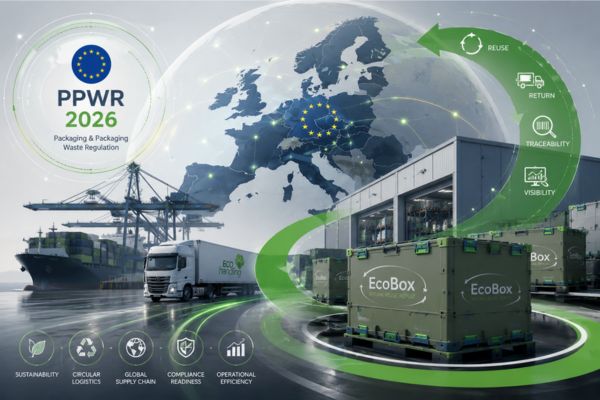
Packaging Is Becoming Part of Supply Chain Infrastructure
One of the most important changes introduced by PPWR is the growing expectation that packaging will no longer be viewed as disposable transport material. Instead, it is increasingly becoming part of the infrastructure supporting global logistics operations.
Industrial companies shipping products into Europe are beginning to face new expectations regarding packaging lifecycle management, material efficiency, return capabilities, and operational traceability. In practice, this means that packaging decisions are moving beyond procurement departments and becoming part of broader supply chain planning.
European importers are also under pressure to improve reporting capabilities related to packaging waste, recovery processes, and circular logistics initiatives. As a result, reusable packaging systems are gaining attention not only for sustainability reasons, but also for operational and financial considerations.
Across operational discussions taking place within global logistics programs managed by EcoHandling, many companies are already examining how reusable packaging infrastructure may support future European supply chain requirements. The conversation is increasingly moving beyond packaging itself and toward long-term operational efficiency and supply chain readiness.
Exporters and Importers Are Becoming Operational Partners
The movement toward reusable packaging models is also changing the relationship between exporters and importers.
Historically, many supply chains treated packaging responsibility as ending once the shipment arrived at destination. Under emerging European expectations, the discussion increasingly continues after delivery. Questions regarding packaging collection, return flows, reuse cycles, and packaging ownership are becoming more relevant across international trade operations.
Importers are beginning to evaluate whether suppliers can support long-term reusable packaging programs rather than one-way shipping models. This creates a new operational dynamic where exporters and importers must coordinate packaging movement across multiple logistics stages.
The shift is especially important for companies operating regular shipment programs into Europe, where reusable logistics flows may generate long-term operational advantages through reduced waste handling, lower packaging replacement frequency, and improved packaging visibility.
EcoHandling is increasingly seeing growing interest from both exporters and European importers looking for more structured return logistics models capable of supporting reusable packaging flows across multiple destinations and operational partners.
Traceability and Visibility Are Becoming Central Requirements
Another major development linked to PPWR is the growing importance of packaging traceability.
Supply chain operators increasingly need visibility into where packaging assets are located, how they move between facilities, and whether they are being reused efficiently. This trend is pushing companies to evaluate packaging tracking capabilities alongside traditional logistics KPIs.
In many industries, packaging is starting to function more like a managed operational asset rather than a consumable shipping expense. This requires greater coordination between logistics teams, packaging engineers, warehouses, and transportation partners.
The ability to support return flows, packaging monitoring, and operational visibility is expected to become increasingly valuable as European supply chains continue transitioning toward more circular logistics structures. Reusable industrial platforms such as EcoBox are increasingly being evaluated as part of these broader operational discussions, particularly in industries operating continuous cross-border shipment programs.
The Market Is Moving Toward Reusable Logistics Models
The transition toward reusable packaging is not happening only because of regulation. It is also being driven by operational realities inside global supply chains.
Companies are facing increasing pressure related to packaging waste handling, material costs, storage efficiency, supply chain resilience, ESG expectations, and transportation optimization. Reusable packaging systems are increasingly viewed as part of a broader logistics strategy focused on long-term operational stability and improved supply chain coordination.
As European markets continue moving toward circular logistics principles, many companies are beginning to evaluate how packaging infrastructure can support both compliance readiness and operational efficiency simultaneously.
Within this changing environment, supply chains are gradually shifting away from one-direction packaging flows toward more structured return and reuse networks. Companies already investing in reusable packaging operations, reverse logistics coordination, and packaging visibility may find themselves better prepared for the next phase of European supply chain evolution.
The movement toward reusable and traceable packaging systems is no longer limited to sustainability discussions. It is becoming part of the future operating model of global trade entering Europe, and companies such as EcoHandling are already participating in the operational transition toward more connected and circular supply chain networks.